An article by Olivia Mattar
To reflect on women’s bodies is to reflect on cultural ideals and how the archetype of a woman has changed across the decades. In determined eras, through art, fashion, architecture and common-sense beauty, it is possible to understand people’s way of thinking in different cultures and times. Going back to ancient Greece and analyzing their sculptures, for example, only by appreciating them, it gives the spectator the perspective of the ideal body when it comes to men and women: The sculptures primarily portray Greek gods and goddesses, such as Aphrodite, with soft bodies and curvy figures, to emphasize fertility and nourishment. Meanwhile, gods are portrayed in ways that enforce strength, but maintain its moderateness and proportion as symmetry and harmony, which are some of the most important factors for beauty in ancient Greek aesthetics.


(1) Aphrodite of Knidos (4th Century BC). (2) Hermes of Praxiteles of Olympia (4th century BC).
In Europe aristocracy, between the 1400s and the 1700s, the female body was voluptuous and curvy in different forms. In the 1400s, when lower classes began to watch and follow along the fashion of the elite, the silhouette was sinuous with no rigid restrainings and some volume in the stomach was valued as it was a sign of nourishment and fertility. Chemises and light weight fabrics such as linen were worn as undergarments; there wasn’t structured underwear molding the body beneath the clothes. Dresses had full long skirts and either tight or loose fitted kirtles with long sleeves.

Giovanna Tornabuoni, Domenico Ghirlandaio (1488).
As the centuries went by, the ideals shifted: The corset was invented and the bodies became extremely restricted with stays. Flat, conic torsos and wide hips created by panniers were worn by young women looking for marriage. This restricted look lasted until the late 1790s, when the female figure got softer again; stays became less strict and the panniers were replaced by small, soft bumrolls. Gradually, gowns had grown looser and high-waisted skirts created a column shaped figure that became the silhouette ideal at the end of the 18th century until the mid 1820s.


(1) Portrait of the Marquise d’Antin, Jean-Marc Nattier (1738). (2) Portrait of a Young Lady in White, circle of Jacques-Louis David (1798).
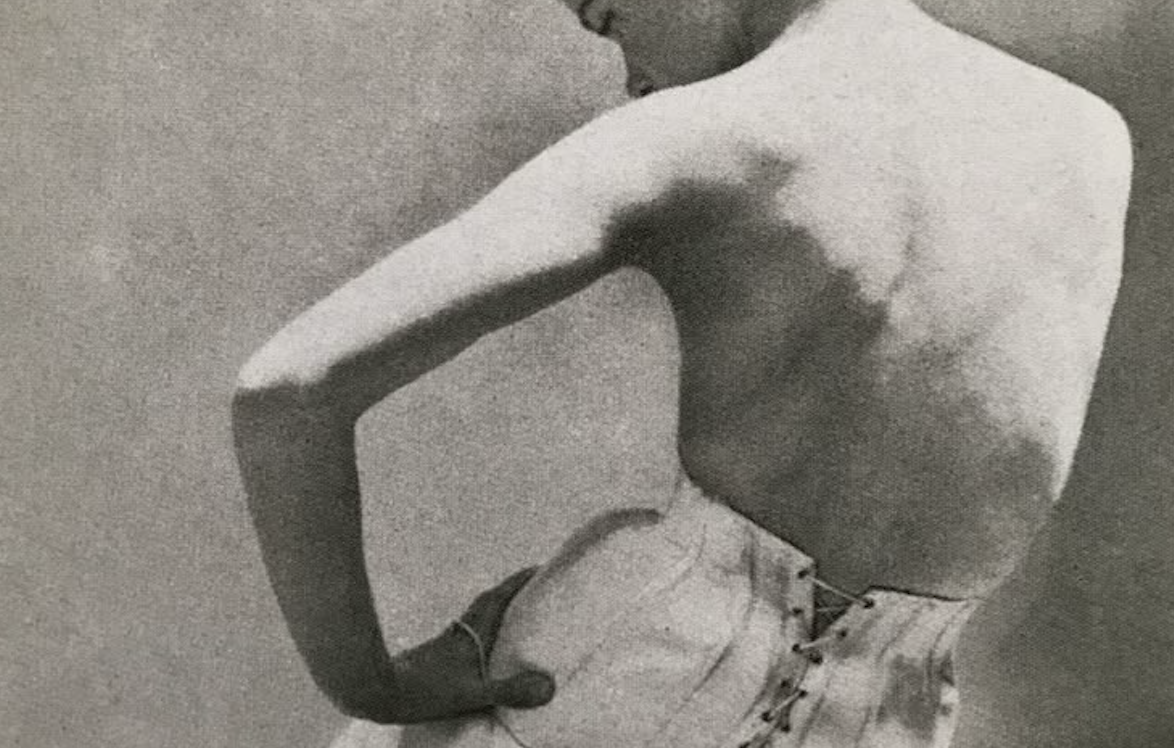
The romantic era starts when the neoclassical one ends, the waist slid back down to its natural placement and the triangular shaped torso was back in style, until one of the most radical shifts in silhouette so far occurred. In the beginning of the 20th century, the curvy, cinched waist and heavily boned corsets — to the point where it shifted women’s organs and at times would even cut through their skin — suddenly ebbed in fashion to give light to curve-less, slim bodies. The media claimed this shift to be a liberating style and it was assumed all women would now be emancipated from the restraints of the corset, but a malleable, moldable body is changed when restricted to the same form for a long time. In the short period of time, the Edwardian ‘S’ silhouette was straightened and curvy women who had spent the last decade transforming their bodies as a consequence to corsets, still had to wear restraining undergarments to fit in the societal idea of what a female body should look like. Observe the Victorian and Edwardian silhouette in juxtaposition to the 1920s one in the following illustrations:


(1) Unknown Artist: Illustration from the Ladies Home Journal (1900). (2) Illustration by Bolin, Vogue (1929).
Not only had the shape of these women’s bodies changed, but it is noticeable that the corporal expression went from strict and postured to relaxed and irreverent. These images not only evince the contrast between ideal body types in different periods, but also a divergence in women’s behaviour; the trending lifestyle shifted. World War I (1914-1918) provoked many disruptions; US and European governments asked for women to stop buying steel-boned corsets as a conservation measure to save the metal for building weapons and with men serving in the army, upper class women had to start to work. In fashion, that meant clothes getting practical, loose and comfortable. As the war ended, there was no need to spare the material and women still had to fit in the ideal silhouette.
The difference between the corset worn in the Victorian hourglass and Edwardian ‘S’ shaped silhouettes and the ones worn to fit in the tubular form, despite their different objectives when it came to the contour they created, is that in the 1700s, the structure that held the body in shape was knowingly there, as the 1920s ones weren’t ideal to wear because female bodies were now supposed to be free to move and dance. That was possibly the moment the body shape itself became an important trend to be followed in order to fit in a way of living. Now what was fashionable was a lifestyle that demanded not only the specific silhouette, but also a body that could easily fit into it, ideally without the help of corsets or stays.
The 1920s were indeed a moment of female freedom to move, dance and loosen up the garments, but it is interesting to reflect on which of these women could actually be free and which ones had to remain restricted. Considering the glaring economic inequality at the time, the glamorous parties with accelerated dancing were only frequented by the urban elite, and as though white women finally achieved the right to vote, black women — as well as black men — struggled to exercise theirs. Rigid policies such as literacy tests — which white people didn’t have to take — and high fee polls had to be overcome for black people to be able to vote and even after this, they were still at the risk of facing extreme acts of violence for voting. Therefore, it is clear that the female freedom of the 1920s was only for the white and wealthy women.
Going back to body standards, the 20th century was the first time thin figures such as this were desired and broadcast. Subsequently, the longing for a small body has been haunting women, even after the end of the tubular silhouette. Since then, waists cinched again, went up, got back down and the one thing that didn’t change is that to be small is to be desirable. In the 80s, for example, the culture was clearly body obsession and gym centered lives with the aerobics boom.
In the time line between then and now, the levels of thinness fluctuated. In the mid 2010s body positivity had risen after the extremely thin body trend era of the 2000s ended and, despite the fact that the pressure of skinniness still existed, it had less significance. Medium and plus sized models were broadcast in clothing websites, some fashion shows were composed by different body-type models and brands saw it as profitable and joined in as it became popular. It gave many women a taste of actual bodily freedom, instead of one that only certain women with certain body types could enjoy. It wasn’t perfect by any means; decades of activism were capitalised and transformed into superfluous “love yourself” statements, still, body types other than thin ones were in the media being displayed as beautiful instead of being scrutinized, and the representativity was appreciated. Eventually this body positive era that had been constructed since 1969 to only get to mainstream by 2014, ended along with global political shifts.
Accompanied by conservatism ascending all over the world, extreme thinness and the heroin chic trend from the 2000s came back after this short period of time where women got less rigid body rules. The return of a conservative body came along with the loss of bodily autonomy. From anti-abortion policies affecting states in the US to women in Afghanistan being stripped of basic rights, conservative policies are inevitably a threat to basic human rights for minorities. Although “pro-life” policies seem far away from Afghan women being banned from education beyond sixth grade, the situation in the middle east is a clear example of how simple it is to be deprived of the rights conquered from decades of activism.
It is no coincidence that the ascending of conservative policies and the shrunken female body trend happened at the same time. As Afghan women are now unable to occupy spaces such as schools and universities, occidental women are pressured to also take less space. This statement is not, by any means, a form of comparison between these very different levels of suffering, but an attempt to analyze how, globally, women are being belittled in scandalous and violent forms, but also in silent ways that can simply go unnoticed
to the inattentive eye, especially by women who are distracted by diets meant to achieve an unachievable body standard. In an objective point of view, a woman who is constantly preoccupied with encasing her lifestyle into a body so thin it’s unreachable has less energy to think about important decisions being made around the world that affect her own gender, and even her own rights and power.
To be small is the literality of the ideal of a woman not only taking less space, but being less; to be taught to shrink also means to learn to demand less, expect less and lower your voice. When such an extreme body is the ideal one and it seems like everyone is struggling to reach it, skinniness becomes a form of self value and external validation becomes crucial for one’s self esteem, which makes a person psychologically vulnerable and easier to control. Starvation also means vulnerability and to be underfed is to be physically and mentally weak in a world where women are already exposed to violence.
These lean bodies are being sold as the result of a wellness lifestyle to convince women it’s empowering to starve due to the discipline it requires, framing ‘shrinking’ themselves as a valid form of self-care; not only is this a method for women to believe that losing weight is honorable, but also to benefit the beauty industry that manufactures self-hatred, aiming to profit from the insecurities they create by imposing brand new defects accompanied by miraculous solutions that come with a price tag.
When body types become trendy it is critical to understand that fashion started as a meaning for class distinction. Aristocracy dressed to differ themselves from the proletariat and with nowadays globalization and the rise of affordable fashion, the lower classes can more easily afford mainstream types of items. The common sense beauty standard for female bodies has always existed, but the difference this time is that the pharmaceutical industry is a part of it and money can now buy the trending body.
In 2022, Ozempic went viral for major, rapid weight loss, which wildly spread off-label prescribing, resulting in years-long shortage of semaglutide, which was originally developed for type 2 diabetes. For them, this meant interrupting vital medication, changing treatments, blood sugar spikes and strict policies in health insurance. For the upper class, it meant contrasting thinness and, consciously or not, ostentation. These injections can cost up to $1.600 without coverage and the semaglutide boom meant the upper class transformed vital medications and extreme skinniness into fashion and luxury.

Namilia, Summer 2025 – Berlin Fashion Week.
So what happens when everyone can afford these kinds of medications? New weight loss drugs are coming to the market at cheaper prices, starting from $149 monthly and generic semaglutide pills are being made, cutting costs to the pharmaceutical industry and allowing lower prices. Usually, when fashion stops distinguishing class and the working class meets the elite, it shifts. With cheaper weight loss drugs coming to the market, will skinny remain as beautiful as it’s thought to be right now, or will the standards shift once again to maintain distinction? At the end of the day, are people actually convinced it is truly beautiful for a woman to be as thin as possible, or do they simply long for contrast? While waiting for these questions to be responded, attention and mindfulness over the motives everyone seems to think women should have specific kinds of bodies is essential. In a world that believes femininity should be small and weak, the response is to keep nourished, strong and convinced that women should be able to occupy important spaces in society and comprehend their own power, instead of being constantly and morbidly preoccupied over their weight.
Leave a Reply