An article by Palina Zapylenova (part two of a two part series)
As I pointed out in part 1, japandi is about inspiration and transformation of traditional into modern and new. However, there were some cultural misunderstandings present, when Japandi became mainstream. Here are some elements of Eastern culture, specific wardrobe items that could be integrated into Japandi and other styles, but they are part of the history, culture, and national dress of various Asian countries, so it is very important to understand the context of their origin.
Áo Dài


From being a fabric to giving its name to the special type of tunic with high slits on both sides (inspired by Chinese and Cham influences), worn over wide trousers, Ao Dai’s history begins in the 18th century in Vietnam under the Nguyen dynasty. Known mostly as a part of women’s clothing, its shorter version was developed for men. Every region had his own fabric to craft the Ao Dai, which often reflects the landscape and particularity of its agriculture: Northern Vietnam – Silk, Central Vietnam – Brocade, Southern Vietnam – Cotton and Linen.
Even after all these years Ao Dai keeps the philosophy of blending traditions and innovations, that’s why we are not surprised to see how designers and celebrities put it into the spotlight. For example, in 2002 Miss Vietnam Mai Phuong Thuy appeared wearing golden, lotus inspired Ao Dai on stage of Miss Universe. Since then we can see how traditional dress has blended into daily wear, carrying respect to its roots.
Tobi (tobi pants/workwear)


Workwear fashion took hold several seasons ago, and sturdy shoes, work jackets, and pants are no longer surprising; they have become basics. It is worth remembering that everyone’s favorite jeans were originally miner’s clothing.
However, Tobi trousers are not simply inspired by workwear, but are an integral part of the uniform of Tobi Shokunin, literally “sky builders,” who are highly specialized construction workers who operate on scaffolding and tall buildings. Tobi itself is a Japanese word for black kite, so it has a metaphorical meaning because it spends more time in the sky than on the ground, as sky builders do. So tobi pants are recognisable by their extremely loose cut along the entire length with a sharp taper in the calf area. This cut simultaneously preserves freedom of movement and allows the trousers to be tucked into boots without any problems. One of the tasks of tobi is to serve as a natural wind indicator thanks to their volume. Normally made from Heavy cotton, twill, or canvas for durability often in workwear colours: navy, khaki, grey, black, deep green.
If we are talking about integration into fashion, that’s probably one of the easiest examples, because tobi is a huge part of Tokyo street fashion, and can often be seen as a sort of inspiration for designers and fast fashion brands. For example, the viral UNIQLO barrel leg pants, due to their cuts, can be inspired by the tobi pants.
Qipao (or cheongsam)


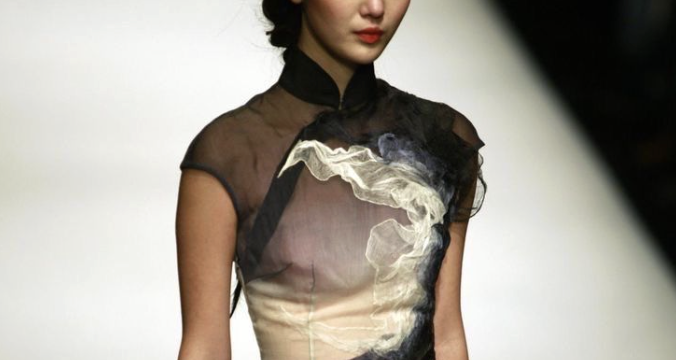
The first and the most important is that it comes from China, not Japan, which is why it’s completely wrong to integrate it into japandi aesthetic. We can even say that it’s culturally inappropriate and that’s what happened to it this season. While talking about japandi people often include qipao into mood boards, but it’s not a style or an aesthetic, it is a chinese traditional dress.
As we know it today, with short sleeves, figure-hugging fit and high cylindrical collar, sometimes with chinese button knot as a detail, it appeared in the early 20th century in Shanghai. In fact qipao’s roots go till the dress of Manchurian people, also known as the Qiren or Banner People, ruled China during the Qing Dynasty (1644 – 1912), which had a purpose of showing the status of them as an upper class. It had a similar slim fit, collar, a cut on one side, but a longer sleeve. Because of the cut on one side women often wore the trousers underneath to cover legs, in fact it wasn’t mandatory. During the May Fourth Movement in 1919, women students went out on the streets dressed in changpao, a man’s version of qipao. As a statement they’ve put on the full-length stockings, that was a celebration of feminine liberation and a sign of changes. After that the story of qipao as we know it have started.
From what we know so far about japandi there are multiple aspects that dragging qipao out of that: used fabric is silk, satin or brocade, which is characterised by shiny touch; color palette is not determined by bright, pastel or muted tones, but normally uses florals, birds or mythological creatures as dragons or phoenix as pattern; tight – fitting cut ads a touch of femininity – all that is opposite from what japandi is about.
There is nothing wrong about wearing a modern version of dresses and tops that are inspired by qipao, they can be made from different fabrics such as cotton or linen or even jeans, in neutral colors and without patterns, short sleeve or sleeveless, those things would add more of a casual touch to it. For example Adidas Chinese new year collection inspired by traditional clothes, had a huge success in the west, but it’s important to understand the roots and cultural significance of it.
Yukata


It’s a sort of a casual version of kimono, which is naturally associated with japanese culture and probably the first thing that comes to mind when we talk about japanese fashion. The main difference would be in terms of tissue. Kimono is more often made from silk, sometimes from brocade, which explains the price and the status seen in it, it’s not a work or home wear. At the same time yukata, while it has the same T form, with long wide sleeves and a belt to keep it all together, originally appeared as an after-bath clothes for the nobles and is made from cotton, cultivation of which had a huge success in Japan during the Muromachi period (14th to 16th century). The wide public welcomed cotton yukata later in the Edo period (17th to 19th century).
There are 3 more details that will differentiate the yukata from the kimono. First is the need to wear underwear, while kimono was made from an expensive tissue that required a different care and can’t be washed as often to keep it in a good condition, yukata is an actual bathwear so can be worn just like that. Two other things are related to couture: if it has two collars and a long sleeve (sometimes even touching the floor, which depends on age, status and type) it’s a kimono, if there is only one collar and sleeve is no longer than 50 cm – yukata.
Nowadays kimono keeps it traditional significance, we can often see it during official ceremonies and events, but that’s a yukata that we can see taking its place in a casual fashion, to be worn in a daily live or to inspire designers and fashion brands, as well as its the one that can easily be integrated into japandi outfit.

Japandi is a clear example of how people can pay tribute to traditions of 2 different worlds. It blends together cultures that seem to be completely opposite of one another, and at the same time acknowledge their differences. Of course there is much more of traditional clothes that was taken as references and became a significant part of fashion, for example Tabi shoes by Maison Margiela inspired by japanese tabi shoes, and popularity of such aesthetics as Japandi is definitely should be the reason for diving deeper in the clothing history before evolving your own wardrobe.
Leave a Reply