An article by Bhavya Reddy
When Will an “Indian Summer” Be Enough?
This year, the so-called “Scandinavian scarf” has made waves in the fashion world. But here’s the twist: it’s not Scandinavian at all. It’s actually a dupatta, a garment that has been a staple of South Asian fashion for centuries. The controversy surrounding this began in early April, coinciding with the release of numerous South Asian-inspired products. According to Google Trends, the day after the “Scandinavian scarf” controversy started gaining attention, interest skyrocketed, with a staggering 955.56% increase in searches from April 13 to April 23.
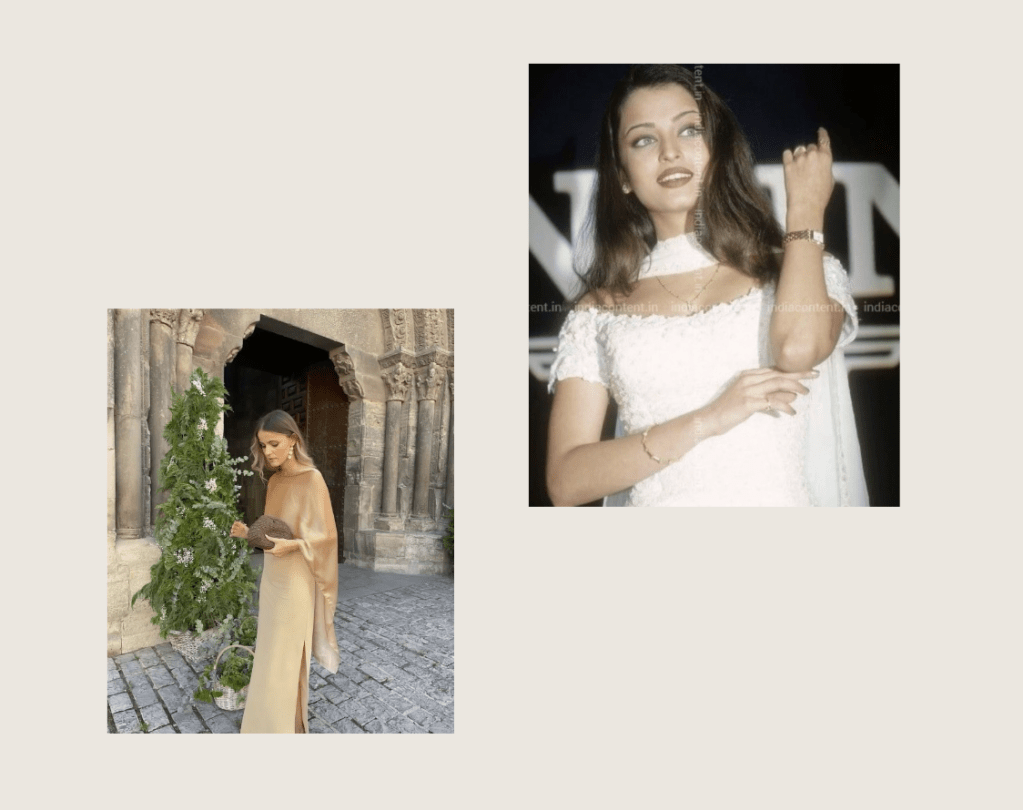
1 – What comes up on Pinterest when searching “Scandinavian scarf outfit,” 2 – Aishwarya Rai in an Indian Dupatta.
This isn’t the first time South Asian culture has been repackaged and sold without acknowledgment. Just last year, the “clean girl” aesthetic and slicked-back hairstyles dominated social media, a look that many South Asians, especially Indians, grew up with. Before, oiling your hair was seen as gross and disgusting; now, the same practice is celebrated as chic and aspirational.
The situation escalated again when Devon Lee Carlson dropped her collection with Reformation. Many were quick to call out the “Lula Top” and “Olivia Low Waist Skirt” for closely resembling traditional Indian attire without recognition. The three-piece outfit, a blue skirt, top, and scarf set, bore striking similarities to a ghagra choli. Don’t get me wrong, the look was gorgeous, but it failed to give credit where credit was due. Despite accusations of cultural appropriation, Carlson denied the claims, stating the collection was inspired by her personal wardrobe, specifically a vintage 1990s John Galliano dress gifted by her mother’s boyfriend.

1 – Devon Lee Carlson x Reformation, 2 – Aishwarya Rai in an Indian Dupatta.
But Reformation isn’t alone. Fast fashion brands like Oh Polly, and even mainstream retailers like H&M and Lovisa, have followed a similar pattern: appropriating South Asian design elements without proper acknowledgment. Oh Polly, for instance, released their “Galia Convertible Gown”, a baby pink jeweled bodice paired with wide-leg pleated trousers, sparking instant comparisons to South Asian traditional wear. Although the brand acknowledged concerns and promised to be “more mindful,” the promotional campaign continued, largely unchanged, weeks later.
Let’s be clear: there is no problem with non-South Asians appreciating or wearing South Asian clothing. Culture should be celebrated and shared. But it must be done with respect. The problem arises when culture is appropriated without acknowledgment– especially considering the historical context of colonization, racism, and cultural shame that South Asians have endured for generations.
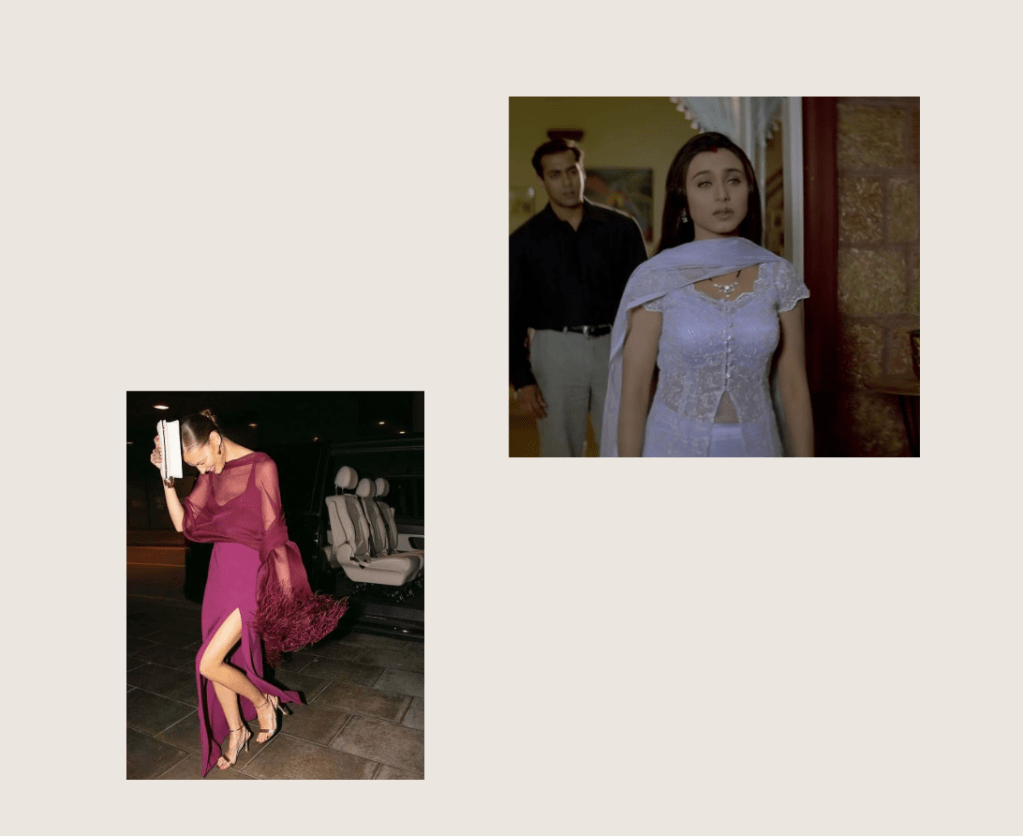
1 & 2 – Another “Scandinavian” and Indian side by side.
When brands like Reformation and Oh Polly lift aesthetics from South Asian culture without honoring the artistry, history, or people behind it, they aren’t celebrating diversity– they’re exploiting it. And the cherry-picking becomes even more blatant when these brands drop “ethnically inspired” collections at a time when anti-South Asian racism is growing globally.
Meanwhile, I see white models on TikTok selling the “very European” idea of the “Scandinavian summer scarf,” pushing a purely European narrative because, in our society, that’s seen as more aspirational. Brands like H&M and Peppermayo have built entire collections off South Asian influence, yet repackaged it in ways that erase the communities that created them. When brands hide or dilute South Asian roots to make their products more “palatable” or “marketable” to Western audiences, they reinforce the same harmful power dynamics that have existed for centuries.
It leaves me wondering: If “Scandinavian summer” is trending now, when will we finally have an “Indian summer”?

 The Violet Post
Leave a comment