An article by Nilani Mathur
As many of you probably know, Coperni turned their Fall-Winter show this Paris fashion week into a LAN (local area network) party, a gathering where gamers come together to play multiplayer video games on their computers. This was a more popularized idea during the 90s and the early 2000s. Evidently, Coperni’s LAN party wasn’t conventional since, of course, it was also a fashion show—but it was also unique in its immensity of scale. The computer setup tables spanned up and down across the Paris Adidas Arena, which has a capacity of about 9,000 people.
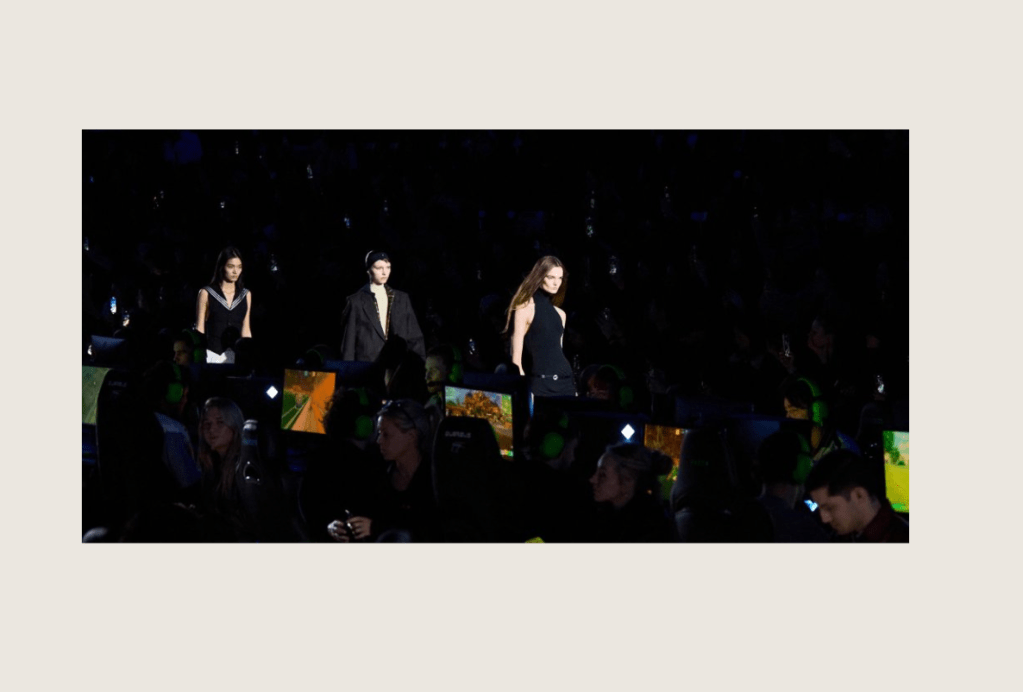
Whether you liked the show or not, it was an remarkably innovative concept. And I honestly think that is where much of the criticism stems from—people feeling the setup was more innovative and impressive than the clothes themselves. Maybe so, but perhaps these kinds of comments are coming from those who don’t accept that an exceptionally clever scene does not, in consequence, deem the collection inherently poor. In fact, I actually think it is really brilliant and kind of the point.
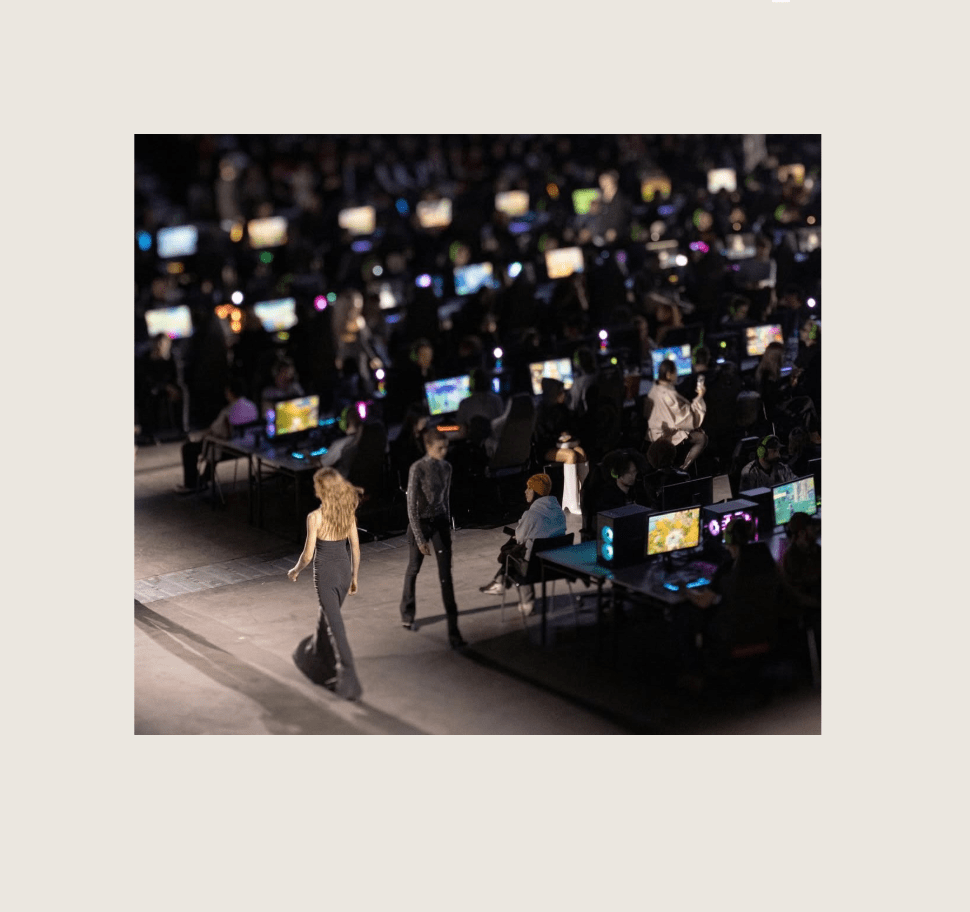
The runway was constructed so that the models would walk up and down the aisles created by the tables. The tables, long and narrow but dense with tech setups on each side, continuously had gamers facing their screens in every other seat, with show attendees sitting between them. As the models made their way down the runway, attendees admired, but the gamers didn’t turn around or even look up from their screens. The arena, so dark that it was almost blue or violet, painted midnight, and even the clothes, sultry, tailored, and fresh, felt somewhat swallowed by the beaming and ongoing action compiled screens. While the runway was graced by interesting cuts, playful material, and even many references to their own digital culture, the gamers were still in their zone. As someone who drinks good fashion like it’s water, this feels like a criminal act. And I’m sure many of you reading this might feel the same. But often now, the stimulation that tech is offering is so immense that it’s steering us away from stimulating our minds with art. Even the art that is meant for us—that appeals to what we already love (the gamers in the show missed out on seeing manifold looks inspired by games like Sailor Moon, Tomb Raider, etc.).
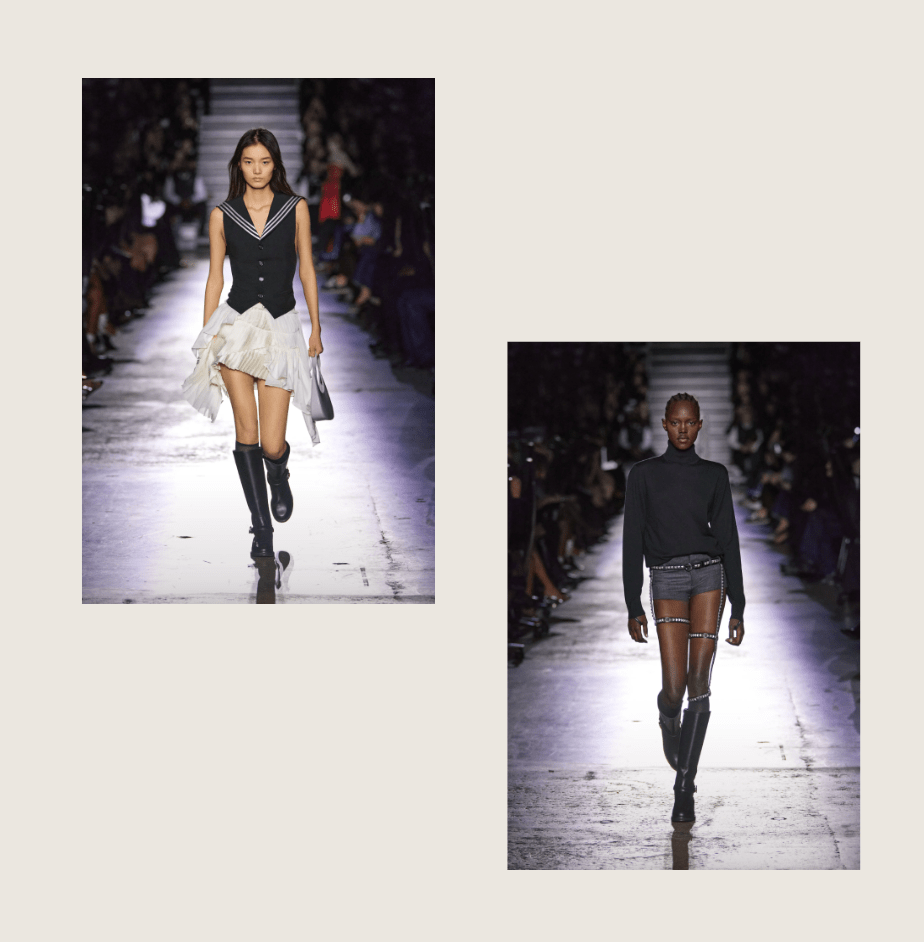
Coperni is intrinsically a technological brand, but they want to show that it can coexist with artistry. According to Vogue, creative directors Sebastien Meyer and Arnaud Valliant “wanted to reflect the human side of gaming as well as the feminine side.” They did precisely that. Each look felt like a realized vessel of a character, not in duplicity but in humanity. Not to mention, the collection is also highly wearable/sellable. The pieces can be easily styled, are incredibly flattering, and are uniquely functional (see the pouches on many of the looks with tights).
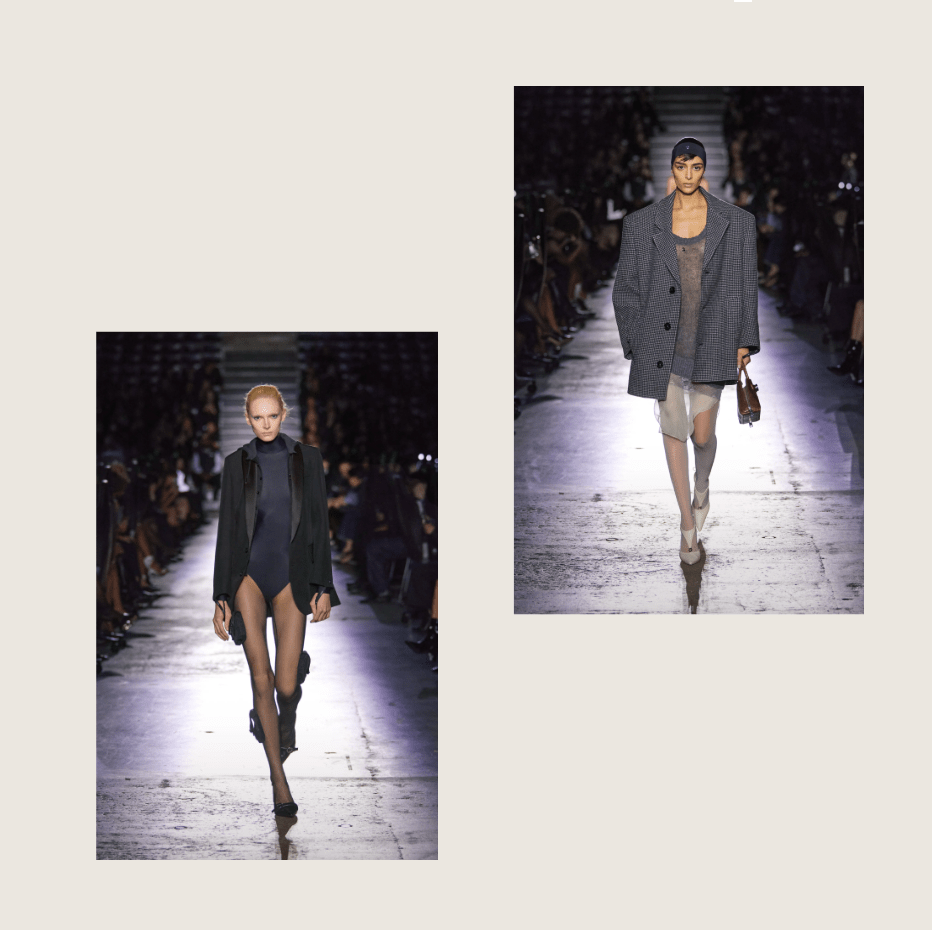
In fashion especially, there is a fine line between gimmicky and extraordinary, and I believe that Coperni is not gimmicky. They are driven by a genuine love of technology, fashion, and femininity, and when those lines cross, there is extraordinary innovation. This season, their Tamagotchi swipe bag was seamlessly nostalgic and inventive at the same time—there aren’t many other brands that are doing just that right now—binding memory with futurism—and I think that is precisely why I fell in love with Coperni.
Growing up in the age of technology and now AI, my attitude towards tech has gone from interested to overwhelmed to frightened quite quickly. When I found Coperni, I loved the clothes incipiently. Yet, when I looked further into the brand, studied its history, and went over interviews, I felt refreshed by how enchanted Valliant and Meyer both were by advanced and modern tech. Before, my mindset was something like this: the robots are taking over, art is under attack, and—will humans even work by the time I’m pacing in the job market? However, Coperni offered me something different: a way to look at technology as a new route of creativity rather than a dead end. Art and technology can not merely coexist but enhance each other when humans apply their imagination (which Meyer and Valliant continue to do). It feels approachable and exciting again to look toward the industry’s future. Of course, there is still much reason to worry about the effects of artificial intelligence on the fashion world. Still, the optimism that Coperni is bringing is inspiring enthusiasm beyond acceptance and truly fostering a safe space from the hysteria that previously restricted my mind and, I’d assume, the minds of many others.
Images courtesy of Vouge.com


 The Violet Post
Leave a comment